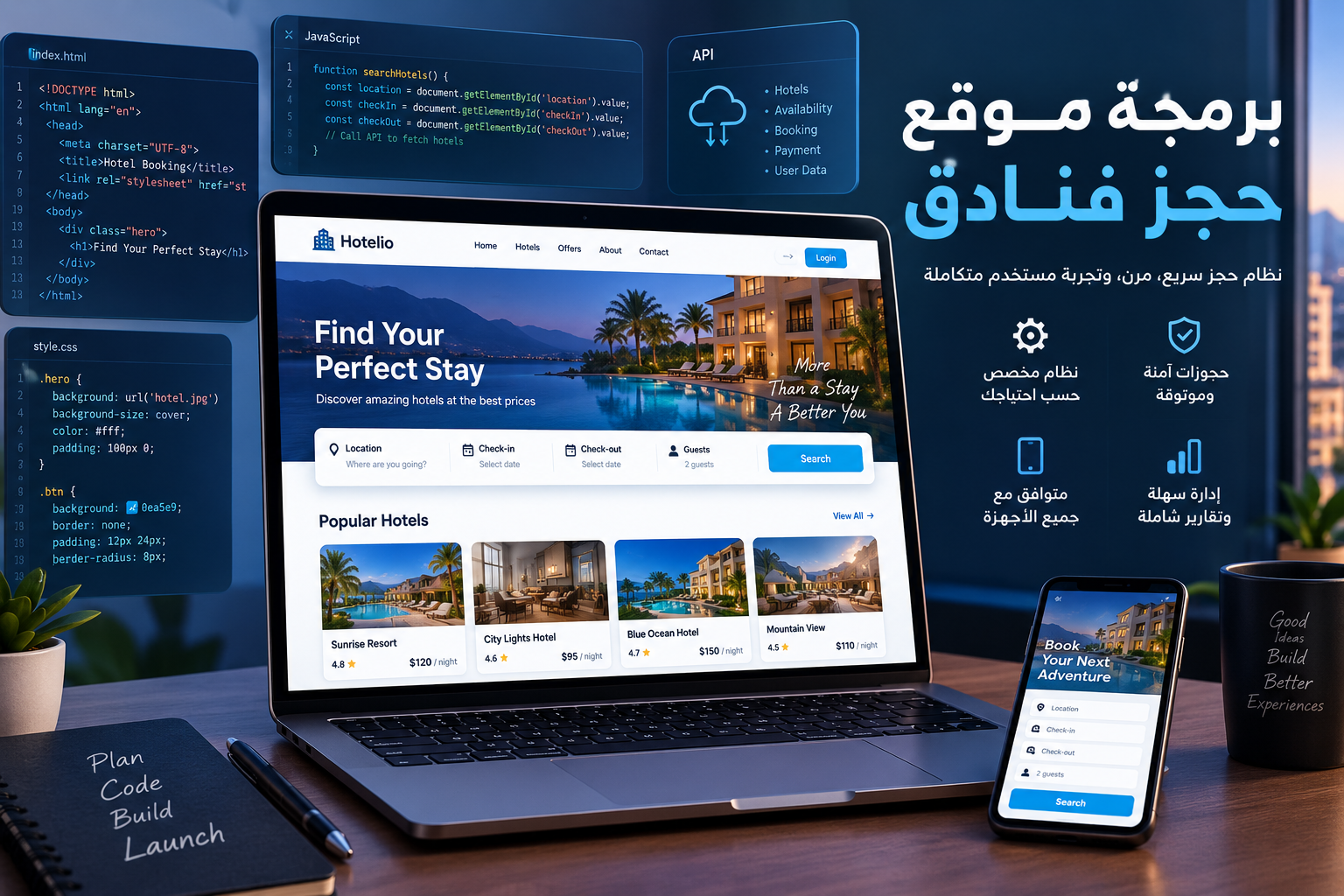
A complete guide to building an OTA hotel booking platform: Channel Manager integration, commission vs. subscription models, and Saudi tourism compliance. Free consultation.
مواقع إلكترونية
Seo Team
September 18, 2026
Updated November 3, 2026
Have a similar project? Talk to the SubCode team on WhatsApp for a free consultation on the right features and steps for your business. Message us on WhatsApp
When someone asks for "a website like Booking.com," they usually mean the surface-level appearance: a search page, filters, a booking button. But what actually powers Booking.com isn't the interface — it's a complete system that manages the real-time availability of millions of rooms, connects to hundreds of content providers, and applies a different cancellation policy for every property. In Saudi Arabia specifically, with the Kingdom preparing for Vision 2030 and hosting major events such as Expo 2030 and the 2034 World Cup, demand for local booking platforms is clearly rising — but entering this space means competing with a global player, which makes it essential to understand the real difference between form and substance before you begin.
The Difference Between a Simple Booking Website and a Full OTA Platform
Criterion
Simple Booking Website
Integrated OTA Platform
Inventory
Limited units updated manually
Real-time sync with hundreds of properties via Channel Managers
Double-booking prevention
Absent or basic
Inventory locking system prevents the same room being sold twice
Cancellation policies
One general policy
A different policy per property (full/partial/non-refundable)
Pricing
Fixed price
Dynamic pricing based on season, demand, and currency
Revenue model
Unclear
Commission per booking (most common) or monthly subscription for properties
Scalability
Limited
Supports thousands of properties, multiple languages and currencies
Core Technical Components
First: Integration with Content Providers (Channel Managers and GDS)
This is the most important technical difference between a genuine platform and a mere front-end website. Booking.com and its competitors pull room and rate data directly from hotels through:
Channel Manager APIs (such as SiteMinder and Cloudbeds), which automatically connect a hotel's Property Management System (PMS) to the platform.
GDS (Global Distribution Systems) for flights — systems like Amadeus and Sabre used to pull flight schedules and fares in real time.
Without this integration, any platform remains dependent on manual updates and quickly runs into the problem of overbooking — selling a room that has already been sold elsewhere.
Second: A High-Performance Search and Filtering Engine
Search results on a platform like Booking.com appear within fractions of a second despite thousands of options (destination, dates, number of guests, price range, rating, amenities). This requires an optimized data architecture (strong indexing), not a traditional SQL query that slows down as the number of properties grows.
Third: A Conflict-Preventing Booking Engine
A temporary hold/lock on a room during payment to prevent another user from booking it at the same moment.
Instant confirmation once payment succeeds.
A cancellation policy tied to each individual property, not a single unified policy.
Fourth: A Multi-Currency Payment Gateway
Support for multiple payment methods (mada, Visa/Mastercard, Apple Pay) and multiple currencies when targeting international tourists, along with compliance with payment security standards (PCI DSS) given the handling of credit card data.
Fifth: A Trustworthy Review System
Genuine reviews made available only after a stay has actually been completed — not an open review field for any visitor — since review reliability is the single biggest trust factor on any booking platform.
Sixth: Separate Dashboards for Each Party
Hotel/property dashboard: updating rooms, rates, availability, and cancellation policies.
Admin dashboard: reviewing new properties, tracking commissions, and performance reports.
User app/website: search, booking, payment, and booking history.
Seventh: Multiple Languages and Currencies
Since a large share of Saudi tourism growth comes from international visitors, the platform needs genuinely high-quality Arabic/English support at minimum — not superficial machine translation.
Revenue Model: Commission or Subscription?
This point matters more than any technical detail, because it shapes the entire system architecture from the outset:
Commission model (the most widespread, as with Booking.com): the platform takes a percentage of each successful booking with no upfront subscription fee on the property — this makes it easier to onboard a large number of properties quickly, but it requires a precise commission-tracking system and monthly financial reconciliation with each property.
Monthly subscription model: the property pays a fixed fee to appear on the platform regardless of the number of bookings — easier to account for, but harder to convince new properties to join initially.
This decision must be made before development begins, as it directly affects the design of the database and the billing system.
Compliance with Saudi Tourism Regulations
This is a mandatory point for any platform displaying accommodation units within the Kingdom. According to the Ministry of Tourism's regulations for hospitality-unit booking platforms:
The platform must display only licensed or authorized units, with information and images that accurately reflect reality.
The trade name and license number and category must be listed for each establishment on the site's own pages.
A clear channel for receiving customer feedback about the service must be provided.
The facilities themselves must be linked to the National Tourism Monitoring Platform.
In other words, the platform must verify each property's license number before publishing it, rather than accepting any property's self-registration without review — a fundamental difference from global platforms that operate under different standards.
How to Choose the Right Company to Build Your Project
Before signing a contract, the following questions should be asked specifically:
Does the company have actual experience with booking engines, not just informational websites?
Can it handle Channel Manager or GDS integration, or will it build a manual update system?
Does it factor in the revenue model (commission/subscription) from the design stage?
Does it account for verifying the licensing of listed properties?
Is the system scalable as the number of properties and bookings grows?
Our Experience at SubCode
On the Sea Tourism project, we worked on transforming a tourism website suffering from low traffic and few bookings into one that converts visitors into actual customers. The solution included technically rebuilding the site, improving load speed, simplifying the booking experience, and connecting the site to content management systems. The result was a noticeable increase in visitor dwell time and booking rate. This experience accurately reflects the nature of the challenges any booking platform faces: it isn't just about an attractive design, but about a digital system serving a clear business objective.
Common Mistakes That Derail Booking Platform Projects
Relying on manual availability updates instead of genuine technical integration, which exposes the platform to overbooking as the number of properties grows.
Neglecting to verify property licenses, which constitutes a direct violation of Saudi tourism regulations.
Applying a single cancellation policy across all properties instead of allowing each property its own policy, which discourages property owners from joining.
Failing to determine the revenue model from the outset (commission or subscription), which delays the design of the entire financial system.
Neglecting the mobile experience, even though most travel bookings happen on mobile.
Next Step
If you have an idea for a tourism booking platform and want to make sure it's built in a way that can scale and complies with Saudi tourism regulations from the start, the SubCode team is ready to listen and show you the right solution, based on real experience building working booking platforms.
Frequently Asked Questions
Do I need to build a mobile app from day one? Not necessarily. If the budget is limited, it's best to start with a strong responsive website first, since it captures search traffic from Google, then add the app once the project proves successful.
Can I start with just one city or region? Yes, this is a reasonable approach, provided the technical architecture is designed from the start to support adding new cities and destinations without a complete rebuild.
Can the platform display international hotels like Booking.com does? Theoretically yes, if connected to global GDS or Channel Manager systems — but this requires commercial agreements with those content providers, not just software implementation.
Have a similar project? Talk to the SubCode team on WhatsApp for a free consultation on the right features and steps for your business. Message us on WhatsApp