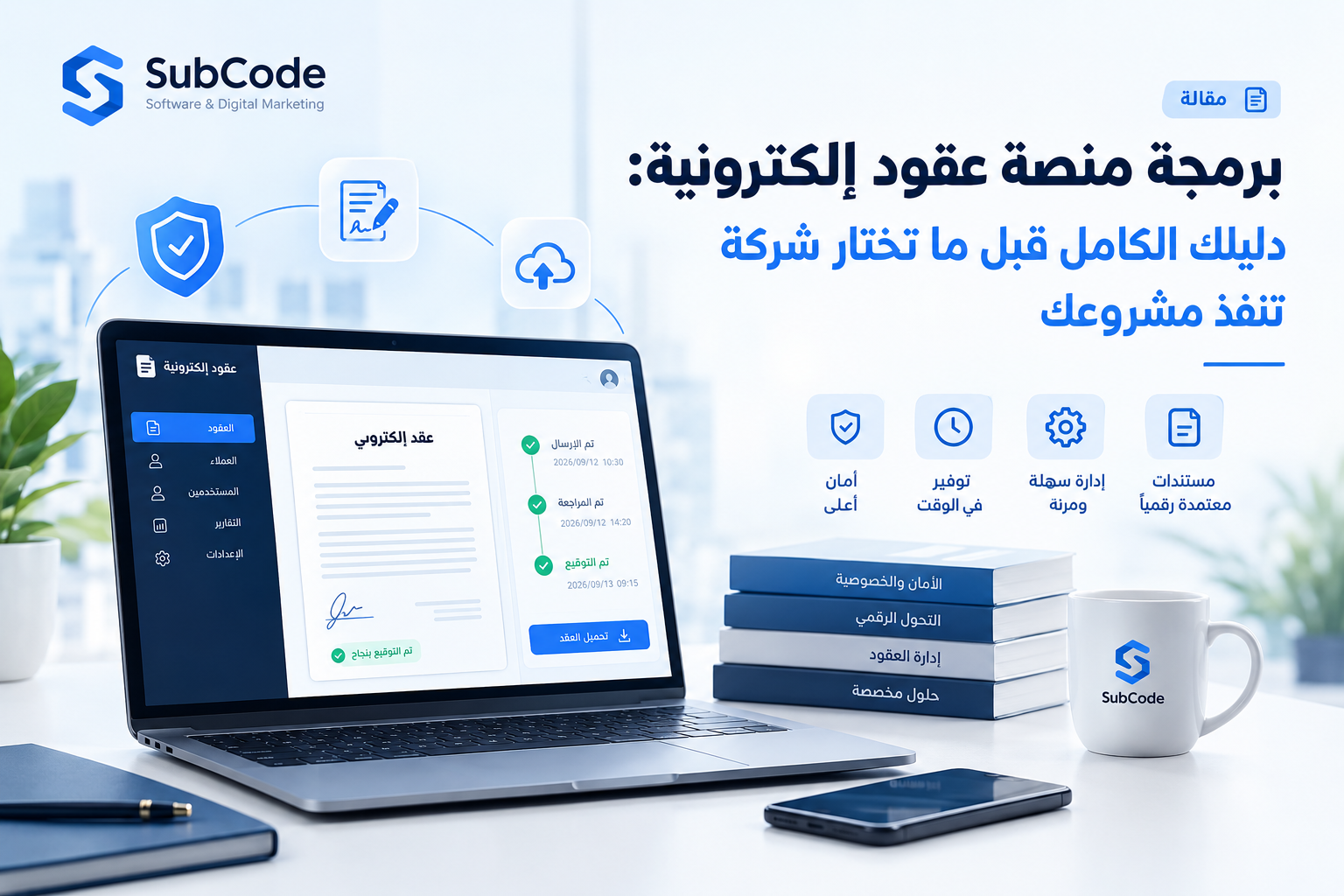
A guide to building an electronic contracts platform in Saudi Arabia: contract types, e-signature, Ejar and Qiwa integration, security, and SubCode's experience building Aqdi.
mobile application
Seo Team
September 13, 2026
Updated November 12, 2026
Have a similar project? Talk to the SubCode team on WhatsApp for a free consultation on the right features and steps for your business. Message us on WhatsApp
Many people in the Saudi market reach a point where they have a clear idea: a platform or app for registering rental contracts, or even a broader electronic contract platform (employment contracts, service agreements, business contracts). But the question that always stops them is: how do I turn this idea into an actual working product, and which company can get this right?
This article walks through what a professional contract platform should look like, the difference between general e-signature tools and a specialized contract platform, and how to choose the right development partner — drawing on our real experience building Aqdi, an electronic rental contract registration platform accredited by the Ejar network that has surpassed half a million users.
Why Has the "Contract Platform" Idea Become a Real Opportunity Right Now?
Different sectors in Saudi Arabia are rapidly shifting to full electronic documentation: rental contracts through the Ejar network, employment contracts through the Qiwa platform, and even electronic signatures themselves are now officially recognized when the platform is licensed by the Digital Government Authority. This means any contract platform idea — whether specialized in a specific sector or general-purpose — has a real market ready to receive it, as long as it's built correctly from the start.
The Difference Between an "E-Signature Tool" and a "Specialized Contract Registration Platform"
Many people with an idea confuse the two, and the difference is fundamental:
Criterion
General E-Signature Tool
Specialized Contract Registration Platform
Purpose
Digitally sign any document
Manage the full contract lifecycle (creation, approval, renewal, archiving)
Business logic
Generic, applies to any sector
Built on the sector's own logic (e.g., lease renewal dates, the Ejar network)
Regulatory integration
Often minimal or absent
Designed from the start to comply with the relevant regulatory body
Users
Anyone who needs to sign a document
Specific parties (landlord, tenant, broker / employee, company) with different roles
If your idea is specialized in a particular sector (like rentals), a general signing tool won't be enough, because it simply won't understand that sector's underlying logic.
The Core Components Every Professional Contract Platform Needs
Legally recognized documentation and e-signing The electronic signature needs to be officially recognized — not just a digital-looking mark on screen. This requires a technical architecture that reliably ties the signature to the signer's verified identity.
A clear workflow for every stage of the contract Creation → review → approval by all parties → final registration → renewal or expiry alerts. If any of these stages is missing, users will end up falling back on paper processes or WhatsApp for the details.
Separate dashboards for each party The landlord sees one view, the tenant sees another, and management has the full picture. The same logic applies whether the platform handles employment contracts or business agreements.
Integration with the relevant regulatory body If the platform specializes in rental contracts, it needs to account for Ejar network requirements from the design stage. For employment contracts, that means Qiwa platform requirements. This integration isn't an add-on — it's part of the system's structure from day one.
Security and encryption for sensitive data Contracts contain sensitive personal and financial data, so the system needs encryption, precise access permissions, and an audit log for every edit or signing action.
Scalability A platform serving a few hundred users in its first month is a completely different challenge from one that has grown past half a million users, like Aqdi. The technical architecture needs to handle growth from the start, not require a full rebuild a year in.
How Do You Choose a Development Company to Build Your Contract Platform?
Ask these questions before signing a contract:
Do they have a contract platform project you can actually try yourself?
Do they account for regulatory requirements (Ejar, Qiwa, Digital Government Authority) from the design stage, or only as an afterthought?
Is the system built to handle user growth if the project succeeds and scales?
Is there technical support and follow-up after launch, or does the relationship end at delivery?
An ordinary development company might be able to build you a simple signing tool, but a company with real experience in registration platforms understands that regulatory integration and security are the core of the project, not secondary details.
Our Experience at SubCode: The Aqdi Platform
One of the clearest examples of our experience in this space is the Aqdi project — an electronic rental contract registration platform, accredited by the Ejar network and the Real Estate General Authority, which we built to help landlords, tenants, and brokers complete a contract in minutes instead of relying on traditional paper processes.
Aqdi isn't a design mockup — it's a product actually running in production that has surpassed half a million users, which means we've genuinely faced every challenge you'd run into: regulatory compliance, security, scaling with user growth, and integrating with the Ejar network from the ground up.
If your idea isn't rental contracts specifically, but a general contract platform (employment contracts, business agreements, service contracts), the same experience in building a secure, scalable registration system applies — with the platform designed around the target sector's logic rather than copying the same solution.
Common Mistakes That Sink Contract Platform Projects
Starting with a general signing tool instead of a specialized platform: if your activity needs sector-specific logic, a generic tool will hold you back quickly.
Postponing regulatory compliance until the last moment: connecting the system to a regulatory body's requirements after launch costs far more time and money than if it were accounted for in the design.
Neglecting the user experience for different parties: a single dashboard for every party creates chaos, especially as the user base grows.
Not planning for scalability from the start: a system that works fine with 100 users can collapse at 10,000 if the technical architecture wasn't built for growth.
Next Step
If you have an idea for a contract platform or app — whether for rentals or any other sector — and you're looking for a technical partner with real experience building working, reliable registration platforms, the SubCode team is ready to listen and show you the right solution for your project, based on our actual experience building Aqdi.
Our real estate services: see everything we build for owners, brokerages and property managers on our real estate software development page.
Frequently Asked Questions
Is the electronic signature on the platform legally recognized? This depends on the platform's own architecture. Properly designed platforms tie the signature to the signer's identity in a reliable way that meets the requirements for legal recognition of electronic signatures.
Can I build a general contract platform that serves more than one sector at once? It's possible, but the more specialized a platform is in one sector (like rentals), the more precisely it can meet that sector's needs. It's usually best to start with one sector and expand later if the idea proves successful.
Can the Aqdi experience be replicated for a sector other than rentals? Yes — the core principles (secure registration, a clear workflow, scalability) apply to any sector, but the details and regulatory integration change depending on the target sector.
How long does it take to develop a complete contract platform? It varies depending on the number of features and integrations required. It's usually best to start with a basic version (MVP) covering core registration, then expand gradually based on actual usage.
Have a similar project? Talk to the SubCode team on WhatsApp for a free consultation on the right features and steps for your business. Message us on WhatsApp