Programming an electronic contracts platform
Many people in the Saudi market reach a point where they have a clear idea: a platform or app for registering rental contracts, or even a broader electronic con
Blog Details
Countries we worked with
 Egypt
Egypt Türkiye
 Germany
 Saudi Arabia
 Qatar
Qatar Syria
Syria Yemen
Yemen Oman
Oman Palestine
 United Arab Emirates
 Japan
Japan
How much does a mobile app cost in Saudi Arabia in 2026? See what drives the price: features, UI/UX, Android and iOS, admin panel and integrations.
mobile application
Seo Team
September 6, 2026
Updated October 19, 2026
If you are planning to launch a mobile application in Saudi Arabia, one of the first questions that naturally comes to mind is:
How much does it cost to develop a mobile app?
The truth is that there is no fixed cost that applies to every project. Every application has different requirements, starting with the number of features and screens, moving through user experience design, and extending to development, backend infrastructure, integrations, security, and scalability.
A simple application that provides a limited number of services is completely different from a full digital platform serving thousands or millions of users and requiring payment systems, notifications, dashboards, external integrations, and scalable infrastructure.
Therefore, when considering mobile app development in Saudi Arabia, the question should not only be about the price. Instead, you should ask:
What does the project need to be built correctly and designed for long-term growth?
In this article, we explore the key factors that determine mobile app development costs, the main stages of development, how to choose the right development company, and SubCode's experience in building digital products, including Aqdi (عقدي), which has surpassed one million users.
Several factors determine the amount of work required for a project and therefore affect its overall development cost.
The first step is understanding the idea behind the application and its purpose.
Is it:
An e-commerce app?
A real estate platform?
A booking application?
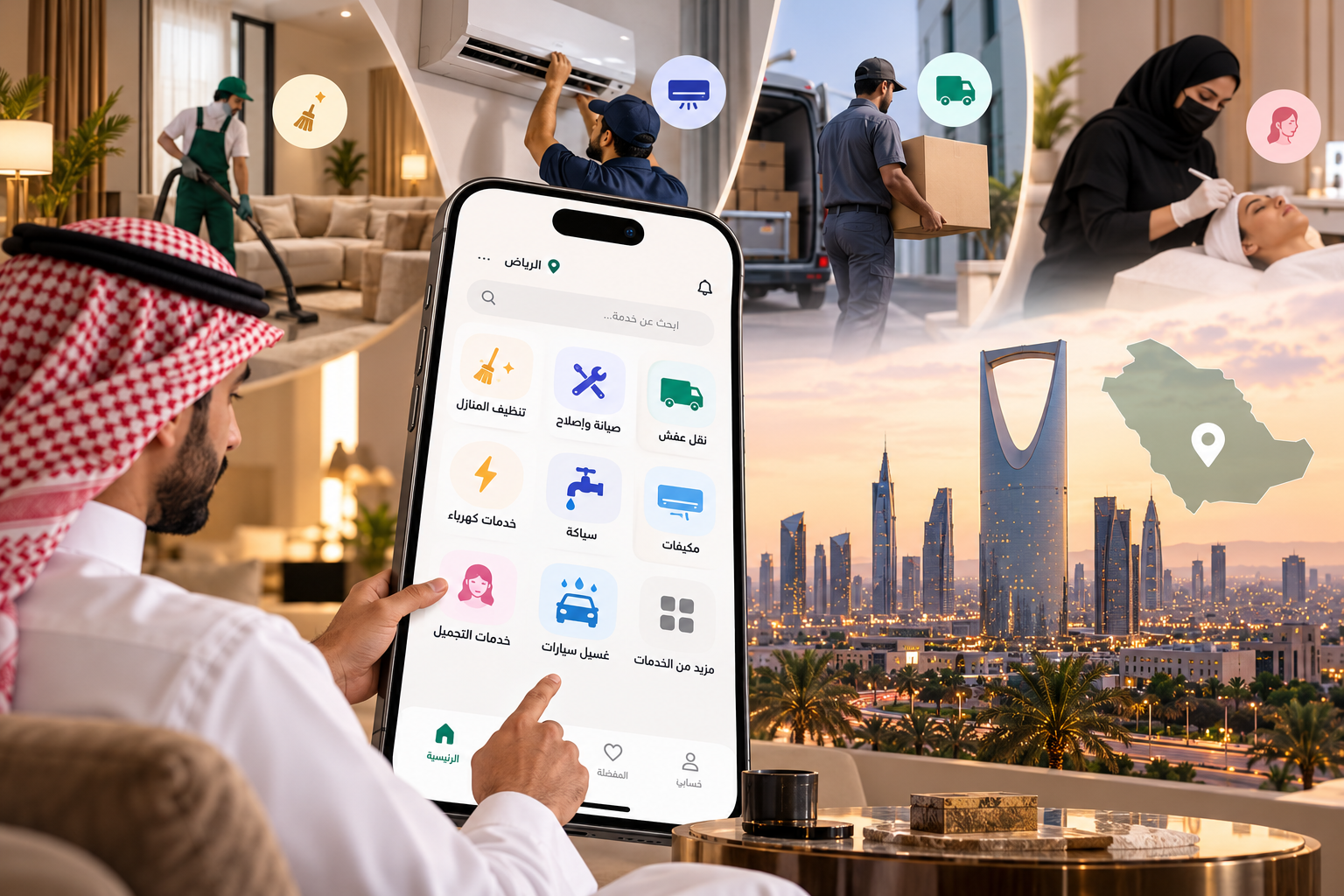
A service marketplace?
A platform connecting users with service providers?
An educational application?
An internal business system?
A SaaS platform?
An AI-powered application?
Each type of project has different technical and business requirements.
That is why successful app development starts with understanding and analyzing the idea, rather than immediately writing code.
Every new feature requires analysis, design, development, and testing.
An application may include:
User registration and login.
User profiles.
Search and filtering.
Push notifications.
Maps and location services.
Booking systems.
Orders.
Online payments.
Subscriptions.
In-app messaging.
Ratings and reviews.
File and image uploads.
Content management.
Reports and analytics.
Loyalty and reward systems.
Artificial intelligence.
The more features an application has, and the more complex the relationships between them, the more detailed the technical analysis needs to be.
Before users start interacting with an application, the user experience needs to be clear and intuitive.
The design phase may include:
User journey analysis.
User flows.
Wireframes.
UI design.
Prototypes.
Different screen states.
Loading states.
Error states.
Success states.
Arabic interface design.
RTL support.
English interface design when required.
The goal is not simply to make the application look attractive, but to make it easy to use and help users accomplish their goals with as few steps as possible.
One of the important decisions at the beginning of a project is determining which platforms are required.
Do you need:
Android?
iOS?
Both Android and iOS?
The right development technology should also be selected based on the nature of the project.
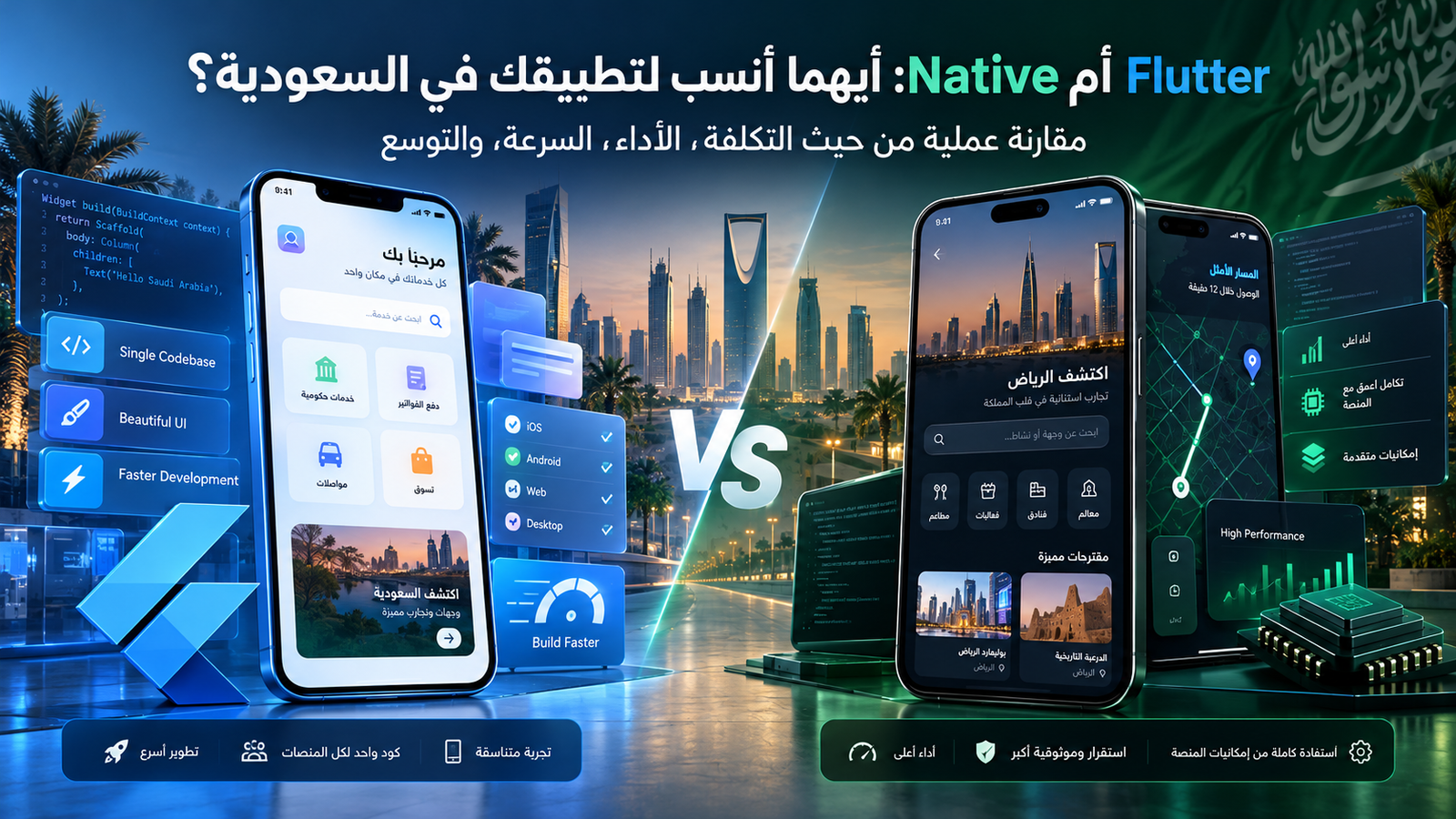
For some projects, cross-platform technologies such as Flutter or React Native can be an effective choice, while other projects may require different technical approaches.
The technology decision should be based on:
The nature of the application.
Required performance.
Features.
Integrations.
Development speed.
Maintainability.
Scalability.
Users see the mobile application, but a significant part of the system operates behind the scenes.
The backend may be responsible for:
User management.
Authentication.
Permissions.
Data management.
Orders.
Bookings.
Payments.
Notifications.
File management.
Reporting.
Integrations.
Business operations.
The mobile application communicates with the backend through APIs.
Therefore, professional mobile app development is not simply about designing screens. It requires building a complete digital system behind the application.
Most professional applications require an admin dashboard that allows the business to manage the system.
The dashboard may include:
User management.
Order management.
Product or service management.
Content management.
Notification management.
Reports.
Analytics.
Permissions.
System settings.
Payment management.
File management.
A well-designed admin dashboard reduces dependency on developers for day-to-day operations and makes the application easier to manage.
An application may need to connect with external services and systems, such as:
Payment gateways.
SMS services.
Email services.
Maps.
Push notifications.
WhatsApp.
CRM systems.
ERP systems.
Identity and verification services.
Artificial intelligence services.
Third-party APIs.
These integrations should be planned during the requirements analysis stage because they can affect the architecture and overall design of the system.
Every application that handles user data needs a strong focus on security.
Security becomes even more important when an application handles:
Personal information.
Documents.
Financial information.
Payment transactions.
Multiple user accounts.
Different permission levels.
Important security considerations may include:
Authentication.
Authorization.
API security.
Encryption of sensitive data.
Secure file handling.
Rate limiting.
Permission management.
Audit logs.
Backups.
System monitoring.
Security should not be treated as something added at the end of the project. It should be part of the system architecture from the beginning.
One of the most important questions to ask before developing an application is:
What happens when the number of users increases?
An application may perform well when it is first launched, but if its architecture is not designed properly, problems can appear as the number of:
Users.
Requests.
Data.
Files.
Daily operations.
increases.
Scalability can involve:
Database architecture.
API optimization.
Caching.
Queues.
CDN.
Query optimization.
Performance monitoring.
Resource management.
Infrastructure architecture.
This is where the difference becomes clear between an application built only for launch and a digital product designed to grow over time.
One of the projects that reflects SubCode's experience in building digital products is Aqdi (عقدي).
Aqdi has surpassed one million users, making it a practical example of the importance of designing a system from the beginning with scalability in mind.
Building a product at this scale is not limited to designing the application and developing its interfaces.
It requires an integrated digital ecosystem that includes:
Designing a clear user journey that allows users to access the required service easily.
Building a backend capable of efficiently managing users, data, and business operations.
Designing the database in a way that helps maintain performance as the volume of data grows.
Building secure and well-structured APIs that connect the mobile application with the backend systems.
Protecting user accounts, data, and different system operations.
Planning for future growth and the increasing number of users and operations the system may need to handle.
One of the most important lessons in app development is that success does not depend only on launching an application, but also on its ability to continue operating and scaling after launch.
The development timeline depends on the size and complexity of the project.
A simple application does not require the same amount of time as a platform with multiple systems and third-party integrations.
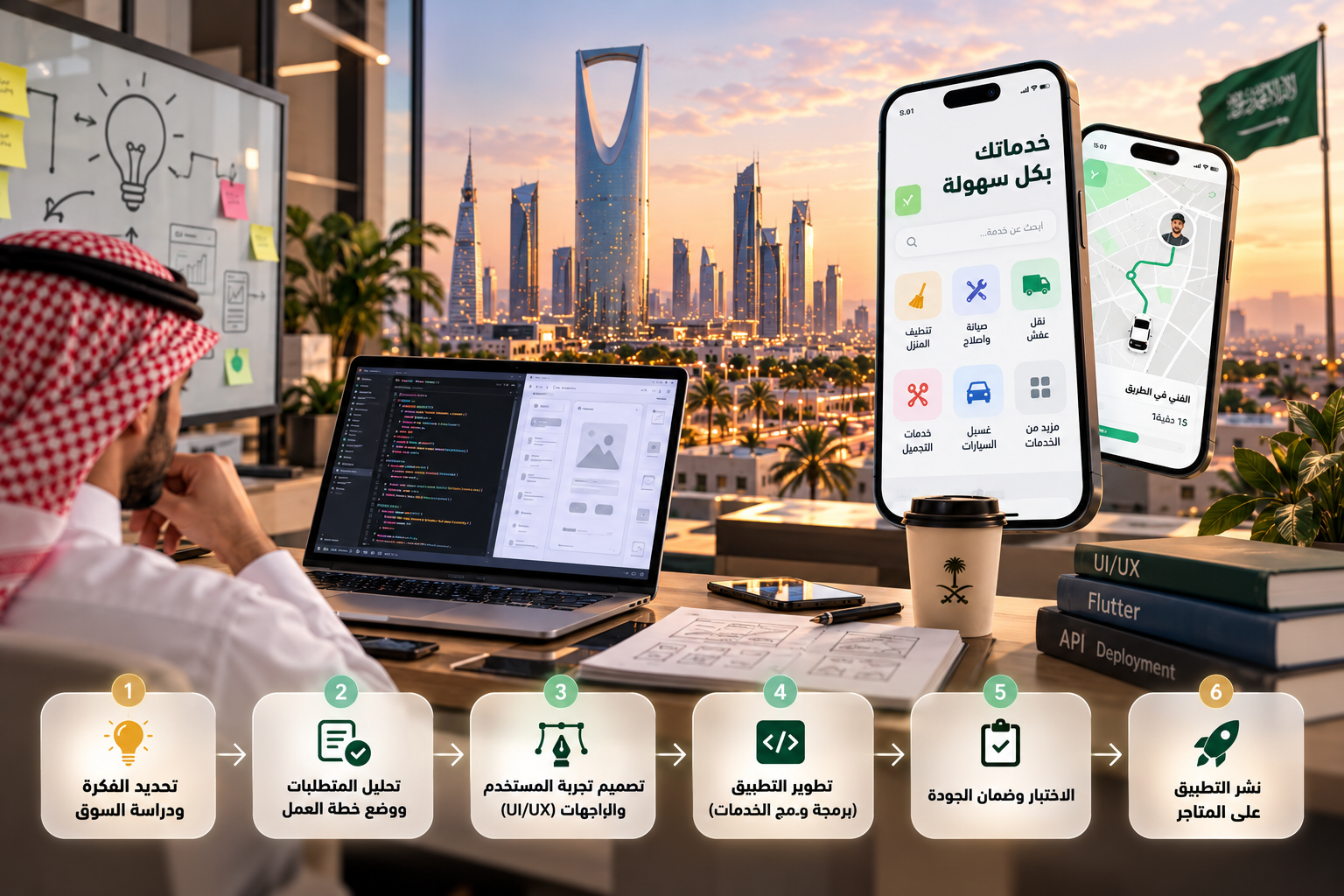
A typical development process includes the following stages:
Understanding:
The project idea.
Target audience.
Application objectives.
User types.
Required features.
Integrations.
Technical requirements.
Turning requirements into:
User flows.
Wireframes.
UI designs.
Prototypes.
Building:
Database architecture.
APIs.
Authentication.
Permissions.
Core business logic.
Turning the approved designs into a functional mobile application for the required platforms.
Building a dashboard that allows administrators to manage data and system operations.
Testing:
Functionality.
Performance.
User experience.
Error scenarios.
Security.
Different devices.
After completing development and testing, the application is prepared for deployment and launch.
But the work does not end here.
Launching an application is the beginning of a new phase.
After launch, the product requires continuous:
Performance monitoring.
User behavior analysis.
Bug fixing.
Application updates.
UX improvements.
New feature development.
Technical optimization.
Dashboard improvements.
Security improvements.
That is why it is important to work with a development company capable of supporting the project over the long term, rather than simply delivering the first version.
Not necessarily.
For many projects, it is better to start with a first version containing the core features. This approach is commonly known as:
MVP – Minimum Viable Product
The goal of an MVP is to launch the core product, test it with real users, and then use the results to determine which features should be developed next.
This can help businesses:
Test the idea.
Understand user behavior.
Collect real feedback.
Reduce risks.
Prioritize development.
Build based on actual data.
However, an MVP does not mean building a weak system. It means building the smallest version that achieves the business objective while maintaining a technical foundation that can support future growth.
Choosing a development company should not be based on price alone.
Before making a decision, ask about:
Does the company have real projects that have already been launched?
Has the company developed applications similar to yours?
What technologies will be used, and how will the system handle future growth?
Does the company have strong backend development capabilities, or does it focus mainly on mobile interfaces?
How will user data be protected?
Does the company have a QA and testing process before launch?
What happens after the application is launched?
Who owns the source code, data, accounts, and infrastructure?
These questions help you evaluate a development company based on the value of the solution it provides, rather than simply focusing on the initial cost.
At SubCode, we believe that app development does not start with code.
It starts with understanding:
The Idea → Users → Business Model → Requirements → User Experience → Technical Architecture → Development → Testing → Launch → Growth
We build integrated digital solutions that include:
Mobile applications.
Backend & APIs.
Admin dashboards.
Digital platforms.
Custom software systems.
SaaS solutions.
Third-party integrations.
Infrastructure.
Continuous maintenance and development.
One of the projects that reflects this experience is Aqdi, which has surpassed one million users and demonstrates the importance of building digital products with growth and scalability in mind.
The cost of mobile app development in Saudi Arabia cannot be determined simply by the name of the project or the number of screens.
The overall scope is influenced by several factors, including:
The complexity of the idea.
Number of features.
UI/UX design.
Android and iOS development.
Backend.
Admin dashboard.
Integrations.
Security.
Infrastructure.
Scalability.
Testing.
Support and maintenance.
The best way to determine what your project needs is to start with a detailed analysis of the idea and requirements, then develop a clear vision for the product, technical architecture, and development stages.
A successful mobile application is not simply a collection of screens on a phone. It is a complete digital ecosystem capable of serving users and growing with them.
If you have an app idea and want to turn it into a real digital product, the SubCode team can help you analyze the idea, define the required features, design the user experience, build the mobile application, backend, and admin dashboard, and prepare the product for launch and future growth.
Start with a clear idea and build a product designed to grow.