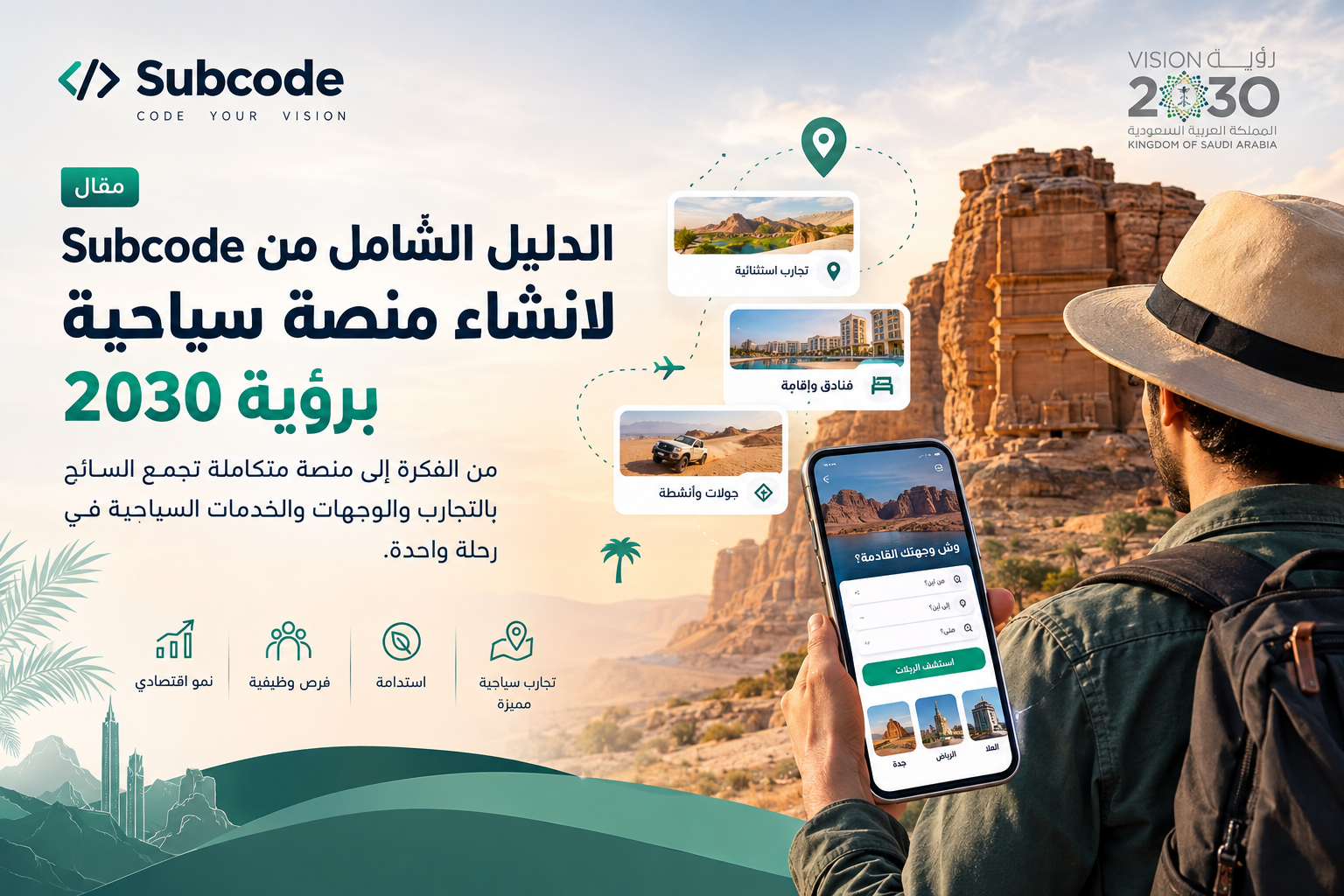
Your comprehensive guide to creating a tourism platform in 2027 and its importance to Vision 2030
A comprehensive guide to building a professional tourism platform in 2027 — Why the sector is a real growth opportunity according to Vision 2030, the essential components of the platform, and SubCode's actual experience in building a C Tourism website.
مواقع إلكترونية
Seo Team
September 13, 2026
Updated November 1, 2026
Saudi Arabia's tourism sector isn't just growing — it keeps hitting its targets years ahead of schedule. Vision 2030's original goal was to attract 100 million tourists; the Kingdom achieved that figure five years early, and raised the bar to a new target: 150 million tourists annually by 2030. With the final stretch of Vision 2030 approaching in 2027, demand for professional tourism platforms and apps is set to rise significantly.
In this article, we explain why 2027 is genuinely a good time to enter the tourism platform market, what a professional tourism platform should look like, drawing on our real experience building the Sea Tourism website.
Where Does Saudi Arabia's Tourism Sector Actually Stand?
The numbers tell a story of unprecedented growth:
In 2025, the number of tourists (domestic and inbound) reached 123 million, including 29.3 million international visitors, placing Saudi Arabia among the top 15 tourism destinations globally.
Total tourism spending exceeded SAR 304 billion (roughly $80 billion).
The tourism sector's direct contribution to GDP reached around 5%, and continues to rise.
Saudi Arabia became the fastest-growing G20 country in international tourist numbers.
Giga-projects like the Red Sea, NEOM, Amaala, Qiddiya, and AlUla are opening up new destinations regularly, and each new destination needs a digital infrastructure to support booking, presentation, and visitor engagement.
Why Is 2027 Specifically the Right Time to Build a Tourism Platform?
Three factors make this timing strategic:
The approaching Vision 2030 deadline is accelerating digital infrastructure: every tourism entity — from a small travel office to a major destination — needs a strong digital presence to capture its share of continued demand growth.
Hosting major global events: Expo 2030, the 2034 World Cup, and global sporting events like the Esports World Cup are creating early demand for digital tourism experiences and bookings years ahead of the events themselves.
The Digital Tourism Strategy and the AI Tourism Vision: the Ministry of Tourism launched a comprehensive digital tourism strategy, and in 2026 launched an AI Tourism Vision as part of the "Year of AI," signaling that the official direction is pushing hard toward smart platforms rather than traditional display-only websites.
The Ministry of Tourism also launched a unified tourism platform to bring the sector's services together in one place — a clear sign that the whole market is moving toward digital integration rather than standalone solutions.
The Difference Between a "Basic Tourism Website" and an "Integrated Tourism Platform"
Criterion
Basic Tourism Website
Integrated Tourism Platform
Purpose
Display information about a destination or service
Enable visitors to search, compare, and book directly
Booking
Contact form or phone call
Instant booking with electronic confirmation and direct payment
Content
Static photos and descriptions
Photos, videos, reviews, real-time availability
Personalization
Same experience for every visitor
Recommendations based on visitor interests
Scalability
Limited
Supports thousands of destinations and bookings without performance issues
If your business depends on converting a visitor into an actual paying customer, a basic informational website won't be enough, no matter how good it looks.
Core Components Every Professional Tourism Platform Needs in 2027
An instant, flexible booking system Turning a visit into an actual booking in a few simple steps, with instant confirmation, is what separates a platform that drives sales from one that just collects visits.
Smart search and filtering Visitors search by specific criteria (destination, date, budget, type of experience), and without precise, fast filters, they'll leave the site within seconds.
Integration with payment gateways and content management systems Reliable payment processing, combined with easy content and offer updates without going back to the developer every time.
Multi-language support Since a large share of growth is coming from international tourists, the platform needs to support at least Arabic and English with genuine translation quality — not surface-level machine translation.
A fast mobile experience Most tourism searches happen on mobile, and a design that starts from a desktop screen gives a poor mobile experience.
Analytics and performance reporting Knowing which destinations are most in demand, where bookings come from, and how visitors behave helps you continuously improve your offers instead of guessing.
How Do You Choose a Development Company for Your Tourism Platform?
Before signing a contract, ask:
Do they have an actual working tourism platform project you can visit and try yourself?
Do they account for the booking and payment experience from the design stage, rather than as an afterthought?
Is the platform built to scale if the number of destinations or bookings grows significantly?
Is there technical support and follow-up after launch?
Our Experience at SubCode
On the Sea Tourism project, we worked on transforming a tourism website that suffered from weak traffic and low bookings into one that converts visitors into actual customers. The solution included technically rebuilding the site, improving load speed, simplifying the booking experience, and connecting the site to content management systems — resulting in a noticeable increase in visitor session duration and booking rate.
This experience reflects exactly the kind of projects we work on: not just a good-looking website, but a digital system serving a clear business goal.
Common Mistakes That Sink Tourism Platform Projects
Settling for a display-only website with no real booking system: this loses you customers who need speed and ease in making a decision.
Neglecting the mobile experience: most visitors search and book from mobile, not desktop.
Ignoring multi-language support: this reduces your ability to reach international tourists, who represent a growing share of the market.
Not planning for scalability: a platform serving one destination today might need to serve dozens if it succeeds, and the technical architecture needs to handle that from the start.
Next Step
If you have an idea for a tourism platform, or an existing tourism website that needs development ahead of the next wave of growth, the SubCode team is ready to listen and show you the right solution for your project, based on real experience building working tourism platforms.
Frequently Asked Questions
Is there still an opportunity to enter Saudi Arabia's tourism sector in 2027? Yes. The sector is still in a phase of accelerated growth, and the official targets (150 million tourists by 2030) still require much greater digital infrastructure to support them.
Do I need a separate mobile app in addition to the tourism website? Not necessarily from day one. If your business depends on repeated engagement (following offers, booking notifications), an app adds real value. Otherwise, a responsive website may be enough in the first stage.
Can I start with a platform serving a single destination and expand later? Yes, that's a reasonable approach, as long as the technical architecture is designed from the start to support adding new destinations without a full rebuild.
How long does it take to develop a complete tourism platform? It varies depending on the number of features required (search, booking, payment, multi-language support). It's best to start with a basic version (MVP) covering essential booking, then expand gradually.